Posts Tagged ‘Cars in the Wild’

The first time I ever saw a Ferrari was on a family vacation in Lake George, New York when I was about 17 years old. It is indelibly burned into my memory: A red Testarossa growling through downtown Lake George on a warm summer night, downshifting for a red light, me running into the middle of the street to stand behind it in awe. And standing there in traffic with my mouth agape, I knew my life would be different forever.

Since they started making roadcars, Ferrari’s bread and butter has been cars like the Testarossa—low, wide, mid-engined, two seat sports cars. That is, until now. Welcome to the seemingly most unorthodox Ferrari ever made, the FF.

804393_10200692750230151_395213433_n

Released in 2011, the FF (which stands for “Ferrari Four”, as in four seats and four-wheel drive) is about as unconventional for the most revered name in motoring as you can get. It is the very first all-wheel drive Ferrari, and instead of a svelte two seat configuration, a slightly ungainly hatchback designed body was penned instead. As you can imagine, when Ferrari first revealed the FF, the purists went nuts. They cried, “Say WHA?!? Ferrari is making a car that ISN’T a dedicated asphalt shredding track weapon? Blasphemy!” This car is Ferrari’s response to an ever changing and evolving marketplace. With the FF, the company is now able to reach into previously untapped markets to scoop up customers who may have never purchased a Ferrari because of the cars’ inherent practical limitations.

And the result? Epic. The FF may look more pedestrian than the 458, F12, or the Enzo, but don’t be fooled. Along with its ability to fit, like, stuff and people inside, it arrives packing a 6.3-liter V12 engine, the largest capacity engine Ferrari has ever created, 651 horsepower, and crushing on road performance. It even passed one of the toughest crucibles of them all—the withering yet hilarious opinions of TV’s most famous trio on Top Gear and it went onto win the show’s ”2011 Estate Car of the Year” award. (‘Estate’ translating into ‘station wagon’ for us ‘Muricans).

And it isn’t just Top Gear that is singing the FF’s praises—Harry Metcalfe of EVO magazine fame took loan of an FF for a week, putting 2000 miles on it and driving through nearly every situation possible—hustling down motorways, tearing up backroads, long road trips, even taking it for a spin around his farm. The car’s innovative four-wheel drive system allowed Harry to literally take the FF offroading. Blimey, Ferrari seems to have pulled it off. Check out the excellent video HERE.

The FF is by no means the most lustworthy or visually appealing Ferrari ever made, but it is an immensely capable machine and a total game changer for the Prancing Horse. Bravo!

- Many thanks to Dan Szczesny for the photo!

Oh, irony, how I love thee. While out hooning an ATV around Wisconsin cornfields with my cousin Jared, we stumbled across this fifth generation Dodge Coronet—produced between 1965 and 1970—abandoned in the woods, tire well deep in sand and dirt. Literally, a car in the wild. My first reaction upon seeing the Coronet was sadness—who would abandon such a vehicle to the relentless clutches of time and decay? My second thought was, “Could  there possibly be a more perfect candidate for a Cars in the Wild post?”

I’d like to think that this particular Coronet ended up fading peacefully into the Wisconsin landscape because its former owner would rather keep it than ship it out for scrap metal. It’s still a sad ending for such a classic car, but it certainly did make for an interesting find. As I’ve discussed before, I’m not a huge fan of older cars, but I do appreciate them and know that many paved the way for the current generation of machines that I deeply adore.

Back in the mid-60′s, you could have ordered your Dodge Coronet in range of different flavors. There was this four-door iteration, and it was also available as a two-door coupe and a station wagon. In 1968, Dodge completely overhauled the Coronet and also released the Coronet Super Bee as a compliment to the Plymouth Road Runner. The addition of the famous Super Bee name to the Coronet gave the car special visual upgrades, as well as a 390 horsepower 440 V-8, upgraded suspension, special wheels, and a fiberglass hood. In 1965 when the fifth generation was introduced, the Coronet became the best selling model in Dodge’s lineup, and the Coronet soldiered on until 1976 when it was renamed the Monaco.

But enough of that learning and factual nonsense, here’s a video of a Coronet Super Bee doing a burnout. That’s better.

I salute you, abandoned Dodge Coronet. May your journey to the great drag strip in the sky be filled with wide open roads, new paint and primer, and shiny memories of your glory days. And no mouse nests.

I understand if you don’t know what car this is. This is undoubtedly the rarest and most interesting car yet featured on Cars  in the Wild. Some cars are so transcendent that you don’t have to know a single thing about them but the minute you see one, you know it is something special. When a Rolls-Royce or a Lamborghini drives by, people without a shred of car geek in them turn to gaze longingly then quickly text their car obsessed buddies. And, there are some cars that being seen driving in them is one of their primary purposes (I’m looking at you Rolls and Lambo). This is not one of those cars. Yes, the giant wing will cause deep boy-racer envy and every cop on the road will do a double-take when the see the flashy red paint, but the Noble M400 is about as far from a poser performance car as you can get.

Google ‘Noble’ and you have to scroll for several pages before you reach the company’s homepage at NobleCars.com. Based in Leicester, England, Noble has been producing cars in small batches since 1999 with only a handful of different models since its inception. The M400—the track oriented version of the Noble M12—features a 3.0-liter twin-turbocharged V-6 that puts out 425 horsepower and 390 pound-feet of torque. What’s most significant about this car, and rings true of Noble’s in general, is the staggering level of performance it delivers for a comparatively small fee. Brand new during its production run from 2004 to 2007, the M400 would run you about $70,000. It may not have the swagger of an Italian exotic, but in return for your hard earned money it will obliterate the run to 60 miles per hour in 3.3 seconds (as fast as a Ferrari Enzo), and pull well over 1.0G on the skidpad. Check out a fun Fifth Gear comparison test with the M400 HERE, and a 2007 review from Car & Driver HERE.

The thing I like most about the M400, however, is that you have to know what this car is in order to buy one. This is not a car you cruise around in to pick up chicks or flaunt your wealth in—although the ride is reportedly very good, which should bode well for delicate female bottoms. Whoever owns this car must understand cars on a different level than someone who buys, say, a Lamborghini Gallardo. While the Lambo is a ridiculously capable performance car, there is a certain brain wave pattern a person must exhibit to purchase one that I don’t think exists for the M400—call it a mix of vanity/bravado/macho. I’d like to assume that the owner of this car (I must meet them!) enjoys track days, knows the Formula 1 champions for the past decade, relishes replacing the M400′s clutch and sipping aged classic Scotch. If I see this car on the road, you can bet I’m going to do everything I can to get them to pull over so I can find out if my assumptions are correct. Is that sketchy? Whatev.

In my feeble brain, the general rule of thumb has always been that the more expensive and powerful a car is, the more I want it. Doesn’t matter if it’s new age or old school, if it makes a ton of power, looks the business, and causes my wallet to wilt in fear, that’s the car I have to own. Take Ferraris for example. Sure, you can tune your GT-R or Audi or Evo to make more power than, say, the Ferrari 458 – there will always be people with a faster car than you, no matter what you drive – but there is something about that emblem, that power, that noise, and that name that makes me want to mash the loud pedal to the floor and ride its sonic waves all the way to Valhalla. Its a strange thing then, that there is a small, inexpensive, and comparatively slow car being featured on this edition of Cars in the Wild. Welcome, everyone, to the car that defies my own status quo – the Subaru BRZ.

Here’s the deal – The BRZ makes 200 horsepower, does the 0-60 mph shuffle in a shade over six seconds, and costs around $26,000. Those figures don’t exactly make me tingly all over, if I’m honest. So if that’s the case, why is this car being featured in the most honorable segment of the most prestigious automotive website in all the land? Because the BRZ does something many high-end sports cars and the great majority of inexpensive cars don’t – it drives. The BRZ was never meant to compete with Chevrolet Corvettes or BMW M3s or Porsche 911s. The premise on which it was built is the same as the one that underpins the legendary Mazda MX-5 (Miata) and the nimble offerings from Lotus – low weight, sublime handling, and the tactile driving experience over bloated belt lines and prodigious horsepower.

200 horsepower may not seem like much (and it isn’t), but when it’s responsible for motivating a relatively svelte 2600 pounds and the whole package has a balanced and progressive chassis, you’re left with a controllable and enjoyable driving experience that focuses on mastering the craft of driving. The BRZ was born from a most unlikely corporate marriage between Subaru and Toyota which actually resulted in the creation of two sister cars to the BRZ – the Scion FR-S and the Toyota GT-86. Here in the US, we only receive the Scion and Subaru versions, while the Toyota badged model is relegated to the European market. The Subaru-sourced 2.0-liter four-cylinder boxer engine sits deep in the BRZ, giving it a terrifically low center of gravity. The fastidious attention paid to balance, weight, and handling by the car’s engineers makes the BRZ a unique and compelling rival to cars like the the Nissan 370Z, Ford Mustang, and the V-6 Chevrolet Camaro. Need proof? Check out this fantastic comparison from Drive on the BRZ and the Mustang HERE.

When perusing the interwebs in search of car reviews and videos (which happens probably more than it should), I naturally default to Googling stuff like “Lamborghini” or “drag racing” or “epic burnouts”. It’s a rare day that I take the time to read or watch something about a car that costs less than several houses and makes fewer than a whole kingdom’s worth of horse-power. That changed, however, with the BRZ. I appreciate it in a different way than I appreciate cars like the Ferrari 458 – it’s a compelling, exciting and inexpensive sports car born out of an inspiration rather than from a marketing team or a budget committee. Thank you, Subaru/Toyota/Scion for making this car. I. Must. Own. It.

There is nothing like a Porsche. There are plenty of manufacturers in the same market, other cars in the same category, but no one does it like the boys from Stuttgart. Some of its competitors are better, while many others get their doors blown off, but the people who own Porsches and drive them and race them are Porsche to the core. The purest iteration of the Porsche language is embodied in the 911, the iconic sports car the company has been making since 1963. And of the innumerable variants of the glorious 911 stands the GT3 – the pure, track focused version of Porsche’s purest automobile.

The GT3 follows a pretty genius marketing plan – charge more and give customers less. Sounds sheisty, but it isn’t. The only things you get less of are weight, distraction, and time spent on each lap of your favorite race track. This particular example (doesn’t it look epic in black?) was spotted at the New Hampshire Motor Speedway two weekends ago during the 24 Hours of LeMons race. Mounted at the back of the GT3 in quintessential 911 fashion, is a 3.6-liter flat-six engine that develops 415 horsepower and manhandles the ever important dash to 60 miles per hour benchmark in 4.1 seconds. Interestingly, Road & Track Magazine recorded a 60 mph run in 3.8 seconds. Competitors and posers will be admiring the size of the GT3′s diesel rear wing all the way up to the car’s top speed of 193 mph.

But, this car isn’t focused only on outright speed – world class handling and neatly slicing a race track to ribbons are the GT3′s true calling. There are very few cars with the balanced nature, communicative feedback, and pure tenacity of a GT3 on full attack. For as much as Top Gear is the outlet TDC turns to for videos and commentary, auto-geek Chris Harris (@harrismonkey) composes some of the most insightful car reviews you can find anywhere. Check out his breakdown of the GT3 by clicking HERE.

Another great thing about Porsche is they are always creating newer and faster variants of their already bonkers cars. Recently they created the GT3 RS 4.0, a car that makes pretty much everything else a few classes up and down the social ladder wilt with terror. A colossal 4.0-liter flat-six that makes 500 horsepower has been shoehorned into the back of the 4.0, resulting in low-3 second sprints to 60 mph. The 4.0 also inherits a range of parts and technology from Porsche’s racing program which make it a barely street legal racecar. Check out another excellent Chris Harris on the GT3 RS 4.0 video HERE.

Thank you, Porsche, for making cars like the GT3 – they are the stuff of dreams!

One of my all time favorite automotive quotes comes from freelance auto journo Andrew Frankel (@Andrew_Frankel). His experience  driving the almighty Bugatti Veyron for the first time is still the best I’ve ever read: “When I finally stopped accelerating I had to slow down and do it all over again, just to make sure I hadn’t been dreaming. Whatever your definition of fast, be it defined by Porsche 911, Ferrari F430 or Mercedes SLR McLaren, the Veyron will take it and, in one instant, burn it before your eyes. Time and distance fuse into one unintelligible fog in your head. In the public road environment, there has never been anything like this.”

I would be so bold as to take that one step further and rewrite it for this week’s Car in the Wild, the Nissan R35 GT-R. “… Whatever your definition of fast, be it defined by a Porsche 911 Turbo/GT2/GT3, Ferrari 430/458/FF, or pretty much anything else you can think of, the GT-R will take it and, in one instant, burn it before your eyes… In the public road environment, nothing can touch the GT-R’s shattering performance for such a bargain-basement price. Supercars costing three times more than the GT-R are robbed blind.”

Like the Veyron, there are few superlatives left to describe the GT-R; they’ve all be consumed ad naseum by anyone who has ever driven one. Its world crushing performance continues to baffle even the most seasoned automotive journalists years after its launch. One of the most interesting things about the GT-R is when you look at it on paper, it doesn’t seem like it would eat some of the best cars on the planet for lunch. A twin-turbo 3.8-liter V-6 under the hood produces “only” 480 horsepower and is responsible for hauling around a rather portly 3,800 pounds. The end result, however, is quite frankly a little ridiculous — this $85,000-ish car sprints to 60 miles per hour in the mid 3-second range, and continues running onto a top speed of 193 miles per hour. Those figures embarrass some of the finest thoroughbreds from anywhere in the world. Subsequent updates to the GT-R increased horsepower to 540, and dropped the 0-60 mph time to a stunning 2.9 seconds. There are only a handful of cars you can buy that are capable of cracking the 3-second barrier, and this incredible performance comes from the same company that produces the Leaf electric car and the Titan pickup truck.

The GT-R certainly isn’t the prettiest car on the road, but it definitely does pack a deadly punch. Since it’s introduction in 2007, the GT-R has been a champion both on and off the track winning multiple racing titles as well as the 2009 International Car of the Year award, and Car of the Year awards from magazines like Top Gear, Motor Trend, and Evo. Admittedly, a lot of Top Gear videos get posted on TDC, but it’s usually for a good reason. Following that tradition, here is yet another hilarious Jeremy Clarkson segment, this time reviewing the GT-R. Enjoy.

In the TDC Dream Garage, there will be a plethora of precious machinery from all over the world — gleaming red Ferraris, bombastic yellow Lamborghinis and naked carbon fiber Paganis from Italy, decadent Bentleys and Rolls-Royces from England, and savagely purposeful BMWs and Porsches from Germany. Amongst them will be an alpine white Nissan GT-R from Japan, bristling with technology and an insatiable Napoleon complex, always looking to land a knockout punch on cars far above its pay grade.

When the Chevrolet Corvette ZR1 first hit the world stage back in 2007, it had about the same affect as when Nissan unleashed its new GTR—people looked at each other in stunned disbelief and said, “It can do what? And it costs how much?” The Zr1, like the GTR,  serves up a heaping platter of world crushing power and performance for substantially less coin than its European rivals. And, unlike more cultured and refined cars like the Ferrari 458 or Porsche GT2, the ZR1 serves up its power in typical American fashion—it takes that heaping platter, smashes it in your face, then punches you square in the gut. The ZR1 is raw, barely refined, and elects to dispense its heavy ordnance with reckless abandon rather than calculated precision. Need proof? See HERE, HERE, and HERE. And dear, sweet Lord, the sound it makes! Listen to THIS!

Sorry for the crappy photo - yet another reason to upgrade to the iPhone.

The ZR1 develops 638 horsepower from its supercharged 6.2-liter V-8 engine, making it the most powerful engine General Motors has ever produced. And unlike so many powerful American cars before it, the ZR1 can actually handle. Like, go around both left and right hand corners. It handles so well in fact that it currently holds the ninth fastest time at the famous Nurburgring circuit in Germany with a blistering lap time of 7 minutes and 19.63 seconds. Only dedicated track cars or soul-shatteringly expensive exotics like the Gumpert Apollo have set faster times than Chevrolet’s American bruiser.

One of the best parts about the ZR1 is that while it is an all-around better car than any of the Corvettes before it, it’s still sensationally vulgar. From the steamroller sized rear tires, to its massively flared wheel arches, to the clear plastic cutout in the hood that allows you to see the supercharger, from every angle the ZR1 looks like a steroid-popping gym meathead with a torn muscle shirt, practically begging you to watch as it flexes its rippling biceps.

And that’s all the more reason to love this car. It’s bombastic style along with its shattering performance, “reasonable” pricetag (just north of $110,000), and dynamic revolution of the American musclecar make it one of the most desirable cars on the road today, and will forever have a reserved spot in the TDC Dream Garage. America, f**k yeah!

Read an interesting fact about the Mercedes-Benz CL recently – Mercedes-Benz will sell as many of these coupes in a year as Ford will sell of the F150 in a single day. In a single day. Not only is that difference so enormously vast it’s actually hard to comprehend, it also speaks volumes about the exclusivity of the CL, and the ubiquity of the F150. Out of all the cars offered in MB’s diverse portfolio, every model except for the G-Class SUV and the SLS AMG supercar sell fewer models than the CL, giving it a rarity that few other cars enjoy.

This particular model, the CL550 4Matic, isn’t barnstormingly fast, it doesn’t hold the fastest lap time at the Nurburgring, and it can’t outgun rivals like the Ferrari 612 in pure power. It’s 5.5-liter V-8 makes 382 horsepower which is enough to motivate the big coupe to 60 miles per hour in about 5.5 seconds, so world dominating power is not its game. What the CL550 does have, however, is class. And it has it in spades. The flared wheels arches, acres of creased hood, and the tight belt line that streaks from front to back, all give the CL550 a distinct and powerful presence on the road. And while there certainly aren’t any ugly cars in the MB’s stable, the CL’s design definitely makes it one of the most attractive. Inside, its standard MB stuff—vast stretches of leather blended together with wood and other high quality materials to create a cosseting and comfortable place from which to command the road.

“That’s all well and good,” you might say, “but a car of this caliber (and pricetag) needs to light my hair on fire and mash my face like Play-Doh when I step on the gas.” Fear not, because you can have your CL with heaping, prodigious piles of righteous horsepower courtesy of MB’s tuning division, AMG. Step up to the CL 63 AMG, and the comparatively piddling 5.5-liter V-8 is replaced with a 6.2-liter V-8 which makes a properly massive 518 horsepower and 465 lb-ft of torque. And if that still isn’t enough, you can dig deep into your wallet and have the CL 65 AMG which dumps the V-8 engine all together, and instead uses a 6.0-liter twin turbo V-12 to bludgeon poorer motorists into submission. The 65′s volcano of an engine churns out 604 horsepower and 738 lb-ft of torque. Yeah, that’s a lot.

The price for this handsome coupe—which is based on the venerable S-Class luxury sedan—is about $80,000 in CL550 trim, and over $130,000 for the CL 65 AMG. That’s also a lot. There will soon be a newer version of the CL-Class hitting the streets when MB launches its refreshed S-Class sometime later this year. Let’s hope the power and class of the current generation continues into the new model. With an emphasis on power. Yeah, lots of power.

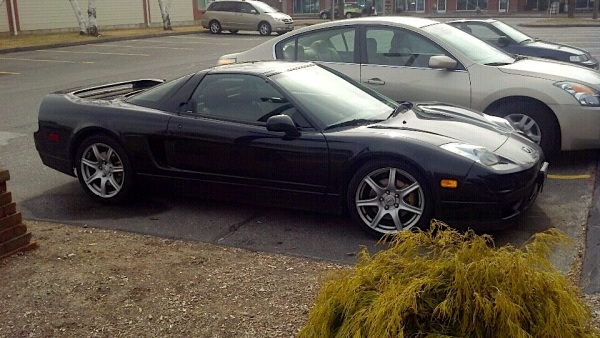
When you think of the early 1990′s, supercars may not be the first thing that pops into your brain. Here’s a list, in no particular order that arrives to mind first: TrapperKeepers, Dennis Rodman, the Goosebumps books, and Salute Your Shorts. And let’s be honest, those aren’t the modern world’s finest moments. When you stop and think, however, you realize that there was some properly epic machinery born from that decade – The McLaren F1, the Jaguar XJ220, the Lamborghini Diablo. These cars came packing outrageous horsepower, massive top speeds and appropriately massive price tags.

And then, there came a car from Japan that managed to fly under the average person’s radar. Some of that is due to the fact that it doesn’t have a gazillion horsepower, doesn’t ooze vulgarity and glitz like Flava Flav’s clock necklace, and doesn’t require the GDP of El Salvador to purchase. Despite all that, this week’s Car in the Wild has maintained its rightful place among the all-time great road cars and spawned an almost cult-like status: The Honda NSX.

Sold as the Acura NSX in the United States, this is a car that true car enthusiasts lust after. It may only have a 3.0-liter V-6 mounted amidships that produces 270 horsepower, but world shattering power was never the NSX’s game – sublime handling in a dynamic and reliable package was. The NSX was produced from 1990 to 2005, and the car pictured here is a later model, made sometime after a worldwide refresh in 2002. When Honda was designing the NSX, they used the venerable Ferrari 328 as a benchmark. Their intention was to create a car that could outperform anything coming from Germany or Italy, in a package that was more affordable and reliable. So did Honda reach their target? Well, let’s have Gordan Murray, the driving mind behind the legendary McLaren F1, answer that:

“The moment I drove the NSX, all the benchmark cars—Ferrari, Porsche, Lamborghini—I had been using as references in the development of my car vanished from my mind. Of course the car we would create, the McLaren F1, needed to be faster than the NSX, but the NSX’s ride quality and handling would become our new design target.” And as if that wasn’t enough, the equally legendary Formula 1 driver Ayrton Senna was instrumental in fine tuning the NSX and it’s other-worldly handling capabilities. (Can you get any more credibility than that? Didn’t think so.)

Shout out to Dave Tracy for sending in this photo. Whoever this is and wherever they live, car enthusiasts the world over thank you for driving this brilliant piece of automotive history. Now hand over the keys and let us drive it. Thanks.

There is something commanding and empowering about driving a luxury sedan. And, when your luxury sedan is a Teutonic titan like the freshly redesigned BMW 7-Series pictured, lesser peoples will actually fall over themselves trying to get out of the way. Cars like the 7-Series look and feel more at home shuttling dictators, monarchs, or pop stars to and fro, and if that’s the look you are going for (which would be a lot of fun, even if you’re not a plutocrat), then this may be the car for you.

In the hierarchy of uber-sedans, which interestingly seems to come mainly from Germany, the 7-Series has always wound up playing second fiddle to the Mercedes-Benz S-Class, the car that practically created the big luxury sedan market, and continues to set the standard for the rest of the luxury sedan world. In the mid 2000′s, BMW fell short primarily because of its hideous iDrive computer system. Confusing menus and incomprehensible commands made the system the bane of every car reviewer’s existence. Fortunately, BMW heeded the hate mail and totally revamped the system. For the 2012 model year, BMW’s flagship also features four wheel steering, a higher use of aluminum to reduce weight, more tech than Bill Gates’ server room, and a night vision camera system that would make SEAL Team Six jealous. Should you wish to have prodigious power reserves to go with your prodigious amounts of class, you can order up your BMW in 760Li-guise that uses Bimmer’s colossal twin-turbo V12 which, besides using the tears of the poor as fuel, makes 535 horsepower, and 550 lb-ft. of torque.

One of the things that BMW focuses on in differentiating the 7-Series from its competitors is “sport.” Normally, sportiness and superior luxury are mutually exclusive terms, but BMW continues to work hard to dispel that notion. Great steaming loads of technology go into the driving experience such as active body roll stabilization, and Driving Dynamics Control, which allows the driver to adjust several driving parameters like suspension setup and steering feedback.

So does the 7-Series finally unseat the S-Class as the superior, superior luxury sedan? Every review you read says the big Bimmer comes close, but once again, it’s no cigar. However, if you’re looking to purchase a car in this class that’s been bred with a little more athleticism in its genes, perhaps the big 7-Series will be your superior choice.